Introduction
Toucans are among the most striking birds in the world, known for their oversized, colorful beaks and playful behavior. This guide highlights five popular toucan species, detailing their appearance, habitat, and social tendencies. Whether you’re a birdwatcher or simply curious about tropical wildlife, these toucans showcase nature’s bold palate and diversity.
1. Toco Toucan (Ramphastos toco)
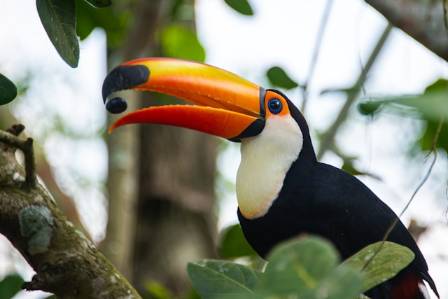
The Toco Toucan stands as the largest member of its family. Its towering beak is a lightweight hollow keratin marvel, designed to reach and peel fruits, help regulate body temperature, and play a role in mating displays. The bird’s plumage is predominantly black, contrasted by a white throat and chest, and blue eyes ringed with orange skin. In dense vegetation, Toco Toucans move with measured slowness, feeding on a varied diet that includes fruits, insects, small reptiles, eggs, and occasionally other birds. Notably, the beak accounts for about a third of its body length and serves as a thermoregulatory heat radiator through blood flow adjustments.
2. Channel-billed Toucan (Ramphastos vitellinus)
The Channel-billed Toucan inhabits South American rainforests and is recognized by its compact body and a striking yellow bill tipped in black, with a hint of red-orange at the base. This species often forms groups and communicates through distinctive calls, while its diet centers on tropical fruits acquired with its sizable beak.
3. Keel-billed Toucan (Ramphastos sulfuratus)
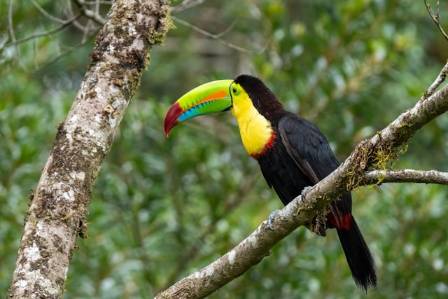
The Keel-billed Toucan, widespread from Central to South American rainforests (including the western Central Valley), features a bill painted with green, red, blue, and orange hues. Despite the bill’s lightness, it supports feeding, mating displays, and defense. In humid, elevated forests, keel-billed toucans travel in groups and use calls to communicate and mark territory, all while showcasing agile flight.
4. Yellow-throated Toucan (Ramphastos ambiguus)
Also known as the Black-Mandibled Toucan, the Yellow-throated Toucan graces Central and South American rainforests. Its plumage is primarily black, with a vivid yellow face and throat, accented by crimson under-bands and, in subspecies, eye-ring and mandible color variations. The beak enables the bird to harvest fruit from delicate branches, while its diet includes seeds, insects, small reptiles, and eggs. This species plays a role in seed dispersal as it forages through the rainforest.
5. Red-billed Toucan (Ramphastos tucanus)
The Red-billed Toucan, also called the White-throated toucan, calls the rainforests of South America home. Its most recognizable feature is a large red bill paired with a white throat. Socially, these toucans often gather in small groups and emit distinctive croaking calls, adding to the chorus of the tropical canopy.
Conclusion

From colossal beaks to vibrant color schemes, these five toucan species illustrate the spectacular diversity of tropical birds. Each species blends unique physical traits with characteristic behaviors, from group foraging to distinctive vocalizations, making toucans a vivid emblem of rainforest life.