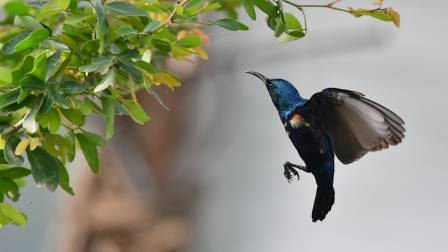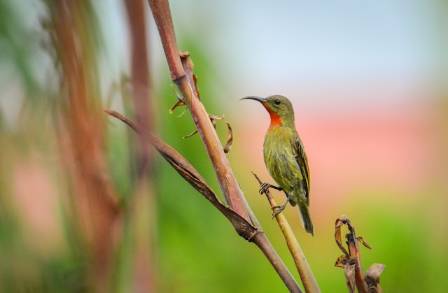
The Beautiful Sunbird (Cinnyris pulchellus) belongs to a family of birds known for their striking appearances. While many of its relatives have names describing specific features—such as the ruby-cheeked or violet-tailed sunbird—this species and its cousin, the superb sunbird, are named simply for their overall aesthetic appeal. These tiny creatures are common in East and West Africa and can be observed in specialized habitats designed to mimic the African landscape.
Physical Traits and Comparison to Similar Species
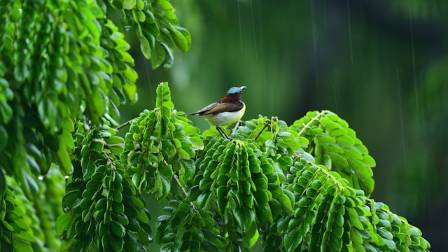
Beautiful sunbirds are exceptionally small, usually measuring just under four inches. During the mating season, males grow elongated tail feathers that add several more inches to their profile. This species exhibits significant sexual dimorphism; males possess radiant, shimmering feathers, whereas females have a more muted and camouflaged appearance.
Although they occupy a similar ecological role to the hummingbirds of the Americas or the honeyeaters of Australia, sunbirds are not closely related to either group. While they share a compact shape and a long, curved beak for gathering nectar, their feeding habits differ. Unlike hummingbirds, which hover in mid-air, sunbirds typically perching on stems or hang from blossoms while eating. Additionally, sunbirds use a tubular tongue to suck up nectar, whereas hummingbirds lap it up.
Behavior, Habitat, and Nutrition
Active during the day, these birds spend most of their time searching for flowers, particularly in open clearings or at the edges of forests where food is most abundant. They have a high metabolism and require constant energy, which they supplement by preening and bathing in local water sources. Their natural range includes a variety of African environments, such as dry forests, savannas, wooded grasslands, and even residential gardens.
The diet of a beautiful sunbird is diverse, consisting of nectar from over 20 types of plants—including aloe and acacia—along with spiders, insects, and fruit pulp. In a managed environment, adults are provided with artificial nectar rich in vitamins and minerals, complemented by fresh produce and insects. Interestingly, beautiful sunbirds sometimes act as "nectar robbers." They use their sharp beaks to pierce the base of a flower to steal nectar, bypassing the plant's reproductive organs and failing to provide the pollination the plant expects in return.
Reproduction and Family Structure
The nesting process is primarily managed by the female. She crafts a purse-shaped, hanging shelter from a mixture of grass, bark, leaves, and feathers, bound together with sticky spider silk. These nests are often camouflaged with lichen or lined with soft materials like vegetable down or even discarded human paper. Inside, she lays one or two eggs and incubates them for roughly a fortnight.
Courtship is a theatrical event where the male performs elaborate songs and dances to win a mate. He displays his bright red and yellow chest bands and flickers his wings and elongated tail. Breeding typically coincides with the rainy season to ensure a plentiful supply of insects for the offspring. While the female handles most of the labor—including building the home and brooding—the male assists in guarding the territory and feeding the young. Hatchlings are born with light down and are ready to leave the nest after about 18 days, though parents continue to provide food for several weeks afterward.
Conservation and Outlook
Communication is vital for these birds, as they use complex vocalizations to defend their space, signal the discovery of food, and interact with their mates and chicks. While they are small enough to be targeted by larger birds and snakes, their populations remain robust.
Currently, the beautiful sunbird is categorized as a species of "Least Concern" by conservation experts, meaning its population is stable and it is not at immediate risk of extinction. They are highly adaptable and can thrive in areas altered by humans. However, maintaining their natural habitats and preventing forest fragmentation remains essential for their long-term survival.