Origami is a timeless craft that transforms simple sheets of paper into intricate works of art. While it is a skill that can be practiced anywhere, its repetitive and focused nature makes it a particularly therapeutic hobby. Whether you are looking for a creative outlet during a period of rest or simply want to add a handmade touch to your home decor, folding paper flowers—specifically the popular kusudama style—is a rewarding project that is much easier to master than it initially appears.
Kusudama flowers are characterized by their five-petal structure and pointed, elegant appearance. While the process involves a series of specific steps, once you develop the muscle memory for the basic folds, you can produce dozens of petals quickly and efficiently. These individual blooms are beautiful on their own, but they can also be combined to create a striking geometric sphere known as a kusudama ball.
Supplies and Preparation for Folding
To begin, you only need a few basic materials. Traditional origami paper is ideal because it is thin and holds a crease well, but this craft is highly adaptable. You can use recycled materials such as magazine pages, old maps, newspaper, or even comic books. If you are cutting your own paper, a square size of 5 inches by 5 inches is recommended.
For assembly, a standard glue stick works well for individual petals. However, for the final assembly of the flower, a fast-drying tacky glue is often more effective. This type of adhesive "grabs" the paper instantly, preventing the petals from sliding out of alignment while the glue sets.
Creating Individual Petals
The foundation of the flower is the petal. Each bloom requires five identical petals to form a complete circle. The folding process begins with a square sheet of paper and involves a sequence of folds that create a small, triangular unit with decorative flaps inside.
Once the folding is complete, you apply adhesive to the outer flap and bring the two sides together, forming a cone-like shape. It is helpful to use your fingers to gently adjust the inner folds of the cone to ensure the center of the petal looks neat and symmetrical. A common strategy for efficiency is to fold all sixty petals needed for a full project first, then move on to the gluing phase in an assembly-line fashion.

Assembling the Completed Flower
When you have five finished petals, the next step is joining them together. A reliable method for achieving a balanced shape is to glue three petals into one group and the remaining two into another. Allow these smaller sections to dry completely before joining the two groups together to form the final five-petal flower.
Viewing the underside of the flower during this process can help you ensure that the points of the petals are meeting at a central axis. While the back of the work may not be as aesthetically pleasing as the front, its structural integrity is vital if you plan to connect these flowers into a larger arrangement.
Variations and Next Steps
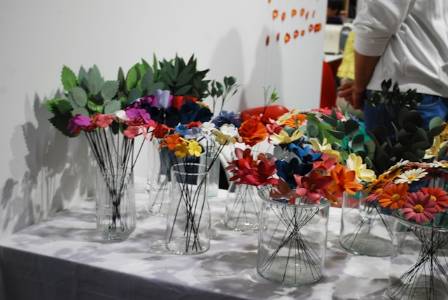
The versatility of origami allows for endless customization. Using "tie-dyed" or patterned papers can result in vibrant, multi-colored blooms that look stunning in a vase or as part of a centerpiece. For those interested in a more ambitious project, twelve of these finished flowers (totaling sixty petals) can be glued together to form a traditional kusudama ball, a classic piece of Japanese paper sculpture.