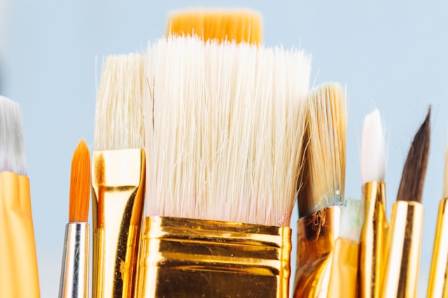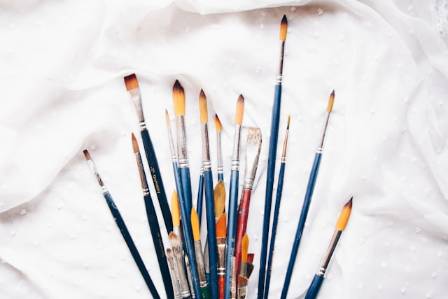
A paintbrush is a fundamental artist’s implement, crafted by securing bristles to a handle with a metal ferrule. These tools vary widely in shape, size, and material, each engineered to achieve specific effects in watercolor, acrylic, or oil media. From creating bold sweeps to rendering fine details, these ten brushes offer a broad palette of techniques suited to diverse creative needs.
Flat-Edge Brushes
Featuring a rectangular profile with squared-off bristle ends, flat-edge brushes are highly versatile. They excel at laying down broad bands of color, filling sizeable areas rapidly, and producing crisp, sharp strokes along edges.
Pointed Round Brushes
With a circular ferrule and tapering to a fine tip, pointed round brushes are ideal for intricate detailing, fluid linework, and curved forms. Their ability to deliver both thick and thin strokes makes them indispensable for precision work.
Synthetic Bristle Brushes
Constructed from man-made fibers like nylon or polyester, synthetic brushes are resilient and maintain shape well. They are especially suited to acrylics and watercolors, offering durability, economical pricing, and easy maintenance.
Natural-Hair Brushes
Composed of genuine animal hair—such as sable, hog, or squirrel—natural-hair brushes retain more pigment and moisture, enabling graceful washes and strokes. They are often the preferred choice for oil and watercolor painting, prized for their responsiveness.
Foam-Head Brushes

These brushes use foam rather than traditional bristles and are commonly employed for broad, smooth coating applications. They’re affordable and disposable, perfect for base layers or varnish, though less precise than bristle alternatives.
Filbert Brushes
Combining features of flat and round brushes, filberts display an oval-shaped tip. They are exceptional for blending colors and crafting smooth transitions or rounded edges, though they may blur finer lines.
Angled Brushes
Also known as slanted brushes, these have diagonally cut bristles. They’re excellent for producing angled strokes and controlled curves, making them useful for both detail and edge work.
Fan Brushes
With bristles fanned out in a wide spread, fan brushes are tailored for blending and softening transitions. They’re often used to suggest delicate textures like foliage or hair, though they aren’t intended for precise detailing.
Bright-Cut Brushes
Similar to flat brushes but with shorter bristles, bright-cut brushes offer enhanced control for compact, heavy paint applications. They deliver bold strokes with precision, though they lack shape versatility.
Water-Flow Brushes
Built with a water reservoir in the handle, these brushes simplify watercolor work by providing continuous wetting of the tip. Available in shapes like flat, filbert, or fan, they’re convenient and mobile, though the water release can occasionally fluctuate.