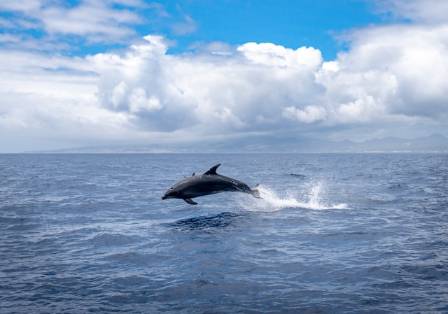
Dolphins are truly remarkable creatures. They are highly social, intelligent, nimble, playful, and often display behaviors and emotions that mirror human traits. Each species possesses its own distinct personality and characteristics, making dolphins fascinating to study and observe.
How Many Dolphin Species Are There?
At present, there are 42 recognized dolphin species divided into five families. The oceanic dolphin family is by far the largest, containing 38 species. The remaining four families consist of river dolphins. However, classification is not an exact science. As research continues and new discoveries are made, some species may be split into multiple species or subspecies.
Dolphin names can be confusing. Eight species include the word “whale” in their name, such as killer whales, pilot whales, false killer whales, and melon-headed whales. Two species combine both “whale” and “dolphin” in their names: the northern right whale dolphin and the southern right whale dolphin, which often adds to public and scientific confusion.
Where Do Dolphins Live?
Dolphins inhabit oceans, seas, and some rivers worldwide. Some prefer coastal regions, while others favor shallow offshore waters.
Orcas are the only dolphins found in Arctic and Antarctic waters. Their large bodies provide extra insulation against the freezing temperatures. Most dolphins thrive in tropical or temperate waters, as their warm-blooded nature makes it easier to maintain body heat in these environments.
Can Dolphins Live in Freshwater?
Certain dolphins, such as the Amazon River dolphin (boto) and the Ganges river dolphin, live exclusively in freshwater rivers and lakes, far from the ocean, earning them the name “true river dolphins.”
There are also populations of dolphins that originated in the ocean but now inhabit freshwater permanently. Examples include the tucuxi (sotalia), Guiana dolphin, Irrawaddy dolphin, and finless porpoise.
Dolphins vs. Porpoises
Porpoises are generally smaller than dolphins, usually under 2.5 meters (8 feet) in length. They tend to be stockier, have shorter heads, little to no beak, and small triangular dorsal fins (except finless porpoises). Another distinguishing feature is their teeth—porpoises have spade-shaped teeth, whereas dolphins’ teeth are conical.

Dolphins vs. Fish
While dolphins and fish share adaptations for aquatic life, there are key differences. Dolphins are mammals, meaning they must surface to breathe air. Fish extract oxygen from water and do not need to come up.
Dolphins evolved from land-dwelling mammals. Their tails move up and down as they swim, in contrast to fish tails, which move side to side.
Dolphins are warm-blooded and have a layer of blubber for insulation. Fish are cold-blooded and adapt to water temperature without body fat. Most fish reproduce by laying hundreds of eggs each year, while dolphins give birth to a single calf every 1–6 years and nurse them with milk.
The Largest Dolphin
The orca, or killer whale, is the largest member of the dolphin family. Adult males can reach 9.8 meters (32 feet) in length and weigh up to 10,000 kg (22,046 lbs). Their striking black dorsal fins can grow up to 2 meters (6 feet 7 inches), making them easily recognizable. At birth, calves measure between 2.1 and 2.6 meters (7–8.5 feet).
The Fastest Dolphins
Orcas are also among the fastest dolphins. In short bursts, they can swim faster than 45 km/h (28 mph), making them highly efficient predators in the ocean.
Dolphins’ intelligence, agility, and complex social behaviors make them some of the most extraordinary and captivating marine mammals on Earth.