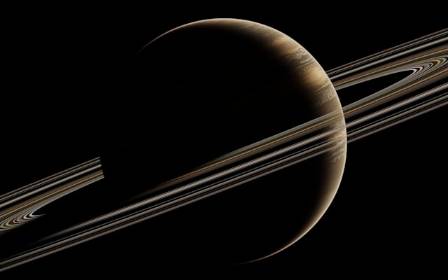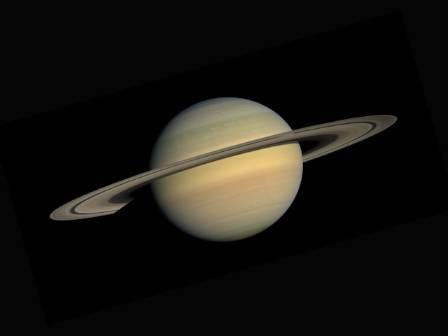
Saturn stands as the second-largest planet in our solar neighborhood, distinguished by a spectacular ring system easily observable through modest telescopes. This gas giant functions almost as a miniature solar system, hosting a collection of complex, planet-like moons that are unique worlds in their own right. Currently, scientists are preparing for the Dragonfly mission, slated for a June 2027 departure, which aims to investigate Titan, the largest of Saturn’s many satellites.
The Significance of Studying the Ringed Planet
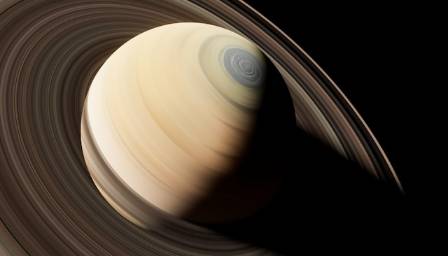
Often referred to as the "Lord of the Rings," Saturn is a massive world with a ring span roughly 27 times the width of Earth. Much like its neighbor Jupiter, it possesses a powerful magnetic field fueled by liquid metallic hydrogen deep within its core. Its upper reaches are defined by intense gaseous storms. Saturn formed approximately 4.5 billion years ago. Theories suggest that both Saturn and Jupiter moved through the solar system during their early stages, their massive gravity redirecting asteroids and comets—some of which may have brought water to the fledgling Earth. Furthermore, studying Saturn provides vital context for the thousands of exoplanets discovered beyond our solar system, including distant worlds that possess ring systems far larger than Saturn’s.
The Nature and Origin of the Rings
Up close, Saturn’s rings consist primarily of water ice particles ranging in size from tiny grains to massive boulders as large as mountains. Within these rings, "moonlets" use their gravity to carve out gaps and create wave-like patterns. Some researchers believe these rings are the remnants of an ancient moon that drifted too close and was pulverized by gravity, while others suggest they are leftover debris from the planet's birth. Regardless of their origin, they are temporary; gravity is slowly pulling the material into the planet, and they are expected to vanish within 300 million years.
A Family of Unique Moons
Saturn is orbited by at least 124 known moons. The most significant among them are active worlds that provide clues about the potential for life elsewhere in the cosmos.
Titan is the largest of these, even surpassing the planet Mercury in size. It is shrouded in a thick, orange haze containing organic molecules—the essential components of life. While it resembles Earth with its mountains, rivers, and seas, these features are made of ice and liquid hydrocarbons like methane rather than rock and water. However, a liquid water ocean is thought to exist beneath its frozen crust.
Enceladus is a much smaller moon, yet it hides a massive secret. Underneath its icy exterior lies a saltwater sea that erupts into space through giant geysers. These plumes contribute to one of Saturn’s rings and contain the organic ingredients necessary for biological life.
Mimas is famously known for a giant impact crater that gives it a resemblance to a fictional space station. Recent data suggests it might also harbor a hidden internal ocean. Other satellites include the sponge-like Hyperion, the two-toned Iapetus, and Pan, a small moon shaped like a walnut or a saucer due to the ring material it has collected.
Scientific Milestones and Exploration History
Humanity’s fascination with Saturn began in the 1650s when Christiaan Huygens first spotted its rings and Titan. Shortly after, Giovanni Cassini discovered further moons and the prominent gap in the rings that now bears his name. In the modern era, Pioneer 11 provided the first close-up look in 1979, followed by the Voyager missions which revealed the planet's frigid temperatures and the chemical makeup of its atmosphere.
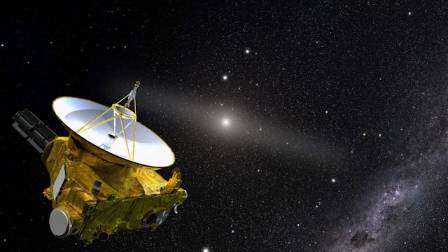
The Cassini-Huygens mission, a partnership between NASA and the ESA, revolutionized our understanding by orbiting the planet for 13 years starting in 2004. It observed seasonal changes, a persistent hexagonal storm at the north pole, and massive weather events that occur once every few decades. The Huygens probe successfully landed on Titan in 2005, providing the first images from the surface of a moon in the outer solar system. Before its intentional plunge into Saturn’s atmosphere in 2017, Cassini discovered that the rings are surprisingly light and likely quite young, perhaps less than 100 million years old.
Future Exploration: The Dragonfly Mission
The next chapter in Saturnian exploration focuses on Titan. The Dragonfly mission will utilize a robotic quadcopter to fly between different locations on the moon’s surface. Because Titan’s current atmosphere may resemble that of an early, pre-life Earth, this mission will explore how organic molecules interact in an environment that has the potential to support life. By studying this "alternate Earth," scientists hope to uncover how life might take hold in environments very different from our own.